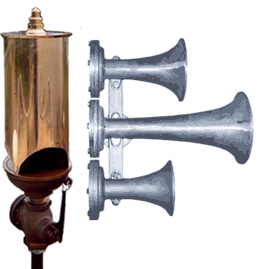
HORN & WHISTLE
Magazine
and Related Technologies
Who's Who at H&W
Publisher/webmaster:
Eric C. Larson
2 Abell Ave.
Ipswich, MA 01938
[email protected]
Editor-in-Chief:
Harry D. Barry
[email protected]
Horn Editor
Ken Kanne
16437 Camellia Dr.
Silverhill, AL 36576
Whistle Editor
Fred Berry
200 Yoakum Parkway
ste. 1300
Alexandria, VA 22304
Horn & Whistle is the quarterly journal of the Horn and Whistle Enthusiasts' Group (HWEG), founded by Jack Hardman in 1982. HWEG is dedicated to the preservation, increase and dissemination of knowledge regarding horns, whistles, sirens, bells and other acoustic devices that are used in signaling, alerting and warning applications in all types of industrial, municipal, maritime and railroad environments and related technologies.
Recent Issues of Horn & Whistle
Restaurants do not typically let you sample their entrees to decide if you wish to eat there. You must order a meal and then see if you like your food, which you will be expected to pay for regardless. However, we're going to let you sample, for absolutely no cost or obligation, some articles that have appeared in recent issues of Horn & Whistle Magazine.
You can download these articles (in convenient PDF format) at no cost or obligation just by clicking the link below. Among the free articles (all of which have appeared in recent issues of Horn & Whistle Magazine) you will receive are these:
- How to sound steam whistles on low-pressure air. If you have steam whistles but no practical way to blow them, here's the way that you can get to hear what they sound like without the need of either high-pressure steam or a large compressor and receiver.
- Blowers for low pressure steam whistle operation. Blowers can supply large continuous quantities of low pressure air for sounding whistles when you use the methods in the above article. But not all blowers are created equal. What are the best blowers to use for sounding whistles? Here, pneumatic engineering consultant “CJ” explains the details of several standard blower types and tells you which is by far the most suitable.
- The nastiest-sounding siren ever created. This siren sounds so bad that it is in reality a really great signal, sought by siren collectors everywhere. Read about it here.
- Demonstrating Steam Whistles. Here, Harry Barry tells you what you need to know if you want to sound steam whistles at some of our events.
- How low a frequency can people hear? If you believe the conventional wisdom that says the human hearing range is from 20-20,000 cycles per second [Hz.] we have some interesting news for you. People can hear sine-wave fundamental tones a lot lower than 20Hz. and we'll tell you about it here. (But you won't get these tones from loudspeakers.)
- Boot Hill is the colloquial name for the Horn & Whistle community's biggest annual steam whistle event. Bring your steam whistles here. They'll let you hook them up to a manifold with 160 PSI steam so you can hear exactly what your prize whistles sound like when operating exactly as they were intended. Sirens, RR Locomotive horns, foghorns and other interesting signals are sounded here as well. Read about Boot Hill here. Where is it, when is it, and how to get there. If you want a truly active hobby where everyone can participate and where you can actually use the articles in collections, then the horn and whistle hobby is just what you are looking for.
And there are other articles here as well. Just click this link and we'll tell you exactly how to claim your free, no obligation sample articles from recent issues of Horn & Whistle Magazine.
Website by H&W web Design Service